An Environmental Pioneer

I started to read Bound for Glory AND the biography of Aldo Leopold. I’m about half way through the former but have finished Aldo Leopold: A Fierce Green Fire by Marybeth Lorbiecki. It was short and I sometimes missed having greater detail about the life of this extraordinary man but I liked the illustrations and feel like I have a good understanding of both his life and times.

I think Leopold’s greatest lesson for us is how he merged his personal and professional lives into a spiritual whole that benefited the world. His early passion for the outdoors as both a watcher and a hunter forged a strong foundation of knowledge, skills and dispositions that made his path seem preordained. Professionally, he helped shape the Forest Service and national wildlife management practices. Personally, his love for the Shack was his personal chance to put his beliefs into practice in a very real way.

Also, the biography shows how Leopold himself learned about living with wilderness. While his path may have been preordained, he did not come into the world knowing the answers. Instead, he used his knowledge and skills to both investigate and learn. For instance, I was surprised at his attitude towards predators like wolves described early in the book. Certainly an environmentalist must understand their role in the natural world. But, I’m writing from a 21st century perspective. Leopold’s early attitude was part of the culture of the first half of the 20th century so it took him some time to break free. Leopold’s editor, Albert Hochbaum, described this learning process:

Albert dashed off one more letter on the subject: Aldo’s unique gift was not that he was “an inspired genius,” he said, but that we was like “any other ordinary fellow trying to put two and two together.” The Professor simply “added up his sums better than most.” Wrong trails taken were as important as right one (p. 167).

The title of the book comes from Leopold’s own description of the moment when he realized he was on the wrong trail when it came to predators as he described fierce green fire in the eyes of  the mother wolf he had shot:

I was young then, and full of trigger-itch. I thought that because fewer wolves meant more deer, that no wolves would mean hunters’ paradise. But after seeing the green fire die, I sensed that neither the wolf nor the mountain agreed with such a view (p. 167).

Leopold was pragmatic about other people’s commitment to wildlife preservation.  When he was accused of only wanting to preserve wildlife so it could be hunted, he suggested that hunters and conservationists needed to work together.  He was also was also honest about his own impact on the world and described a middle way:

I realize, that every time I turn on an electric light…I am ‘selling out’ to the enemies of conservation. When I submit these thoughts to a printing press, I am helping to cut down the woods. When I pour cream in my coffee, I am helping to drain a marsh for cows to graze, and to exterminate the birds of Brazil…What to do? I see only two courses open to the likes of us. One is to go live on locusts in the wilderness, if there is any wilderness left (p. 144).

Lorbiecki goes on to describe Leopold’s other course: “The other, he explained, is to help businesses and consumers become conservation-minded so they find ways to enjoy some comforts of modern life without ruining the land (p. 114).

Like Woody Guthrie, Leopold was a prolific writer.  He had things to tell the world and no matter what else was going on in his life, he wrote and published.  He had good advice for his students who often had to go through multiple drafts before Leopold approved:

Think of it this way. In spite of all the advances of modern science, it still takes seven waters to clean spinach for the pot…And for all my writings to this day, it still takes seven editings, sometimes seventeen, before I let it go off to press.

I wonder what Leopold would think about the more spontaneous nature of much blog writing?

I enjoyed the book, wanted more and have now moved on to Leopold’s own work: A Sound County Almanac.  I’m reading the edition from the 60s that combined his original work with other writing.

New Project 365 Mosaic

Starting with the 26th photo for the year…

mosaic

1. 26/365 for 2010 Muddy Day Walk, 2. 27/365 for 2010 They Don’t Make ‘Em Like They Used To, 3. 28/365 for 2010 My Girl, 4. 29/365 for 2010 Downy Woodpecker, 5. 30/365 for 2010 Decorations, 6. 31/365 for 2010 Rabbit Tracks in the Snow, 7. 32/365 for 2010 Sun and Icicles, 8. 33/365 for 2010 Icicles and Honeysucle, 9. 34/365 for 2010 Baby Sweaters, 10. 35/365 for 2010 Shaker Shells, 11. 36/365 for 2010 Why Do I Always Wait?, 12. 37/365 for 2010 It’s Snowing!, 13. 38/365 for 2010 Mockingbird, 14. 40/365 for 2010 Does Anybody Really Know What Time It Is?, 15. 39/365 for 2010 The Cabin in the Snow, 16. 42/365 Bookshelf Decoration, 17. 41/365 for 2010 Chandelier, 18. 45/365 for 2010 Noble Dogs, 19. 44/365 for 2010 The Garden Gate, 20. 43/365 for 2010Nandina, 21. 49/365 for 2010 Look Up, 22. 47/365 for 2010 Books on the Shelf, 23. 48/365 for 2010 Louise, 24. 51/365 for 2010 White Throated Sparrow, 25. 46/365 for 2010 Cardinal in the Snow

The Life and Times of Woody Guthrie

I declared March to be Biography Month and have finished my first one: Ramblin’ Man: The Life and Times of Woody Guthrie by Ed Cray.  It was first rate and here’s my review which I’ve also posted at LibraryThing:

I didn’t know much about Woody Guthrie except the myth and a few bits and pieces that came out in Arlo’s movie Alice’s Restaurant.  The story behind the myth is much more intriguing and downright tragic.  Guthrie was the outrageous spirit who shocked the world into thinking about things they would rather ignore and who lived out his beliefs each day of his life.  He ignored the niceties and lived close to the bone, hurting in some way almost everyone with whom he came into contact, including his three wives.  At least twice in the book, Guthrie friends comment that people with great talent aren’t necessarily great people.

One particularly intriguing point is made close to the end of the book.  While Guthrie’s family suffered hard times in the depression, his siblings went on to lead fairly prosperous middle class lives. Guthrie chose poverty, his restless nature making a settled life impossible.

Even after finishing the book, I’m not sure I know the real Guthrie. He was depicted as a slovenly, ill mannered man, unable to be monogamous, seemingly determined to annoy even those who loved him almost unconditionally.  Something of a let down for me, I suppose, raised as I was on the myth, and yet there is another side to the story, a sense of something almost mystical about Woody who lived by his own lights and his own thoughts even while trying to find his way in the world.  He was living what others were talking about, using his gifts to bring attention to injustice.

And, what a life he led!  Part of the generation of writers and thinkers whose Communist sympathies were popular during the New Deal but came up against the McCarthy era red hunts.  He seemed to be all over the country and then back again, riding the trains, making detours, writing and writing and writing.  The words seemed to flow from him, the constant no matter where he was, from the woods of Topanga Canyon to the swamps of Beluthahatchee, he wrote…songs, poems, articles, memories, fiction, borrowing typewriter time from friends until he could afford his own.  It was the words that kept him going, the words that told the story of not just Guthrie but of America.

What to Read Next…

Book PileAbout 3/4 of the way through the biography, I downloaded Bound for Glory on my Kindle and started the first few pages.  Now, I’m torn:  Bound for Glory is semi-autobiographical so it would sort of count towards my biographical goal.  But I posted a picture of the month’s reading…I had a plan.  Aldo Leopold is next on the pile and then I’ll probably want to take a detour and read A Sand County Almanac.  What to do?

The suspense builds…

March is Biography Month

Here’s the bad news: I have fallen behind on the 75 book challenge by about two books.  I’m up to 10 but it seemed to take a long time to get through Spirituality for Our Global Community, a choice for my book group.

The prose was oddly stilted and while I’m not sure I didn’t agree with much of what he had to say, the book just didn’t inspire me to action.  He suggested a particular theological base for global community but didn’t offer much in the way of how we might actually get there beyond a vague idea that it involved getting rid of most contemporary religions, or at least all their metaphysical aspects.  Religion would become more cultural with no insistence on truth.   He was a little too rational for me and seemed to dismiss mystical experiences as simply figments of the imagination.  I just had this vision of a secular humanist world, stripped of culture diversity.

In addition, he seemed to paint the world in broad, black and white strokes with many unsubstantiated facts about how the world is going to hell in a hand basket, encouraged along by organized religion.   But I quickly tired of being referred to as “dear reader” when he told me how, “everyone knows” and “it’s a fact ” when indeed I wasn’t sure that was so.  In addition, he suggests that while he encourages you to think about what he says, if you ultimately don’t agree you are a naysayer and a relativist who doesn’t recognize truth when you see it staring you in the face.

I found it hard to read but I finished it and now need to get caught up.  I have an ambitious reading list for March.  All biographies and all for my book group which meets at the end of the month.

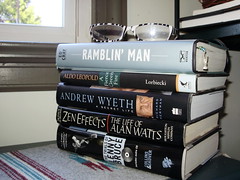
Our group has been together for some time and we’re exploring new ways for choosing books.  So, for next month, we’ve agreed to read a biography that focused on spirituality, peace or social justice.  I am taking a broad view of that and in the interest of getting more serious about my reading, I pulled five biographies off the shelf:

I’m going to start with the Guthrie biography.  Spirituality and social justice expressed through music.  I think it fits.  If I could read all five in March, I would still be a bit behind on the challenge but I would feel very good about chipping a hole in my to be read pile while following through on a serious theme.  Then, I could spend April reading quick fiction and get caught up.

But how to do this?  I need to commit to at least an hour of reading every day, probably two.  And, the older I get, the earlier those hours need to be or I end up sound asleep, book falling from my hands.  So, first thing in the morning seems like the way to go.  I’ve been trying to regulate my work hours–when you work from home, you can work all the time–so I generally don’t settle in for the first email until about 8:30 AM.  With a 30 second commute, I could easily find an hour to read before heading to the office.  A latte, my leather chair, and a good book.  Sounds like a great way to start the week!

I Have Been Reading, Really!

So now I know why people make themselves post every day…if you don’t, you suddenly lift your head and it’s been two weeks!  I have excuses, plenty of them: house sitting in a not-quite-so-connected house, commuting from said house, a bout of some flu bug, work, work, work, and so on.  Nothing special just really off my schedule from the house sitting which leads to a two-hour commute.  I used to do this very commute to my job and I guess you get used to it but the fact is, you are spending two hours a day in the car.  The good news is that I’ve made good progress on my audio book, Girls Like Us, a great history/biography combination that focuses on Carole King, Joni Mitchell, and Carly Simon.

I did finish an early reviewer book for LibraryThing: Frank Delaney’s Venetia Kelly’s Traveling Show.  This time, my review was more in line with the others: this was a terrific book.  So you don’t have to click if you don’t want to, here’s the review.  I gave it four of five stars.

Review of Venetia Kelly’s Traveling Show

This book isn’t just set in Ireland in the early part of the 20th century. The narrator, the other characters, the politics all combine together to create an Irish book, written by a master Irish storyteller. He warns us about digressions and even labels them in their importance and I found myself looking forward to them. Yet, the plot itself, which pulled together classic themes, drew me along, and even now, the ending haunts me. It wasn’t really historical fiction but I learned a lot about Irish politics and appreciated seeing figures like William Butler Yeats, Eamon de Valera, and John Millington Synge included in the narrative. One of the digressions tells the story of Riders to the Sea, my favorite Synge play.

It was a great story interwoven with stories and I enjoyed every word! Yet, I only gave it four stars: I found the ending somewhat abrupt with the various threads coming together too quickly. After many pages of digressions and stories, it suddenly seemed to end.

I haven’t read much this week: just not feeling well, I guess, and mostly sleeping.  I finally started the book group selection, Spirituality for Our Global Community: Beyond Traditional Religion to a World at Peace by Daniel Helminiak. I’m not very far along so I shouldn’t offer an opinion, but I am a little put off by the rather broad brush strokes he paints of our world in crisis.  It’s all bad and getting worse and he’s got the answer to it all.  Hmmm…pretty big claim buddy.  And I suppose if you’re making it, you have to overlook all the pockets of good stuff that might be going on.  I also fundamentally disagree with him about how communities are falling apart.  More later, when I’ve read further.

Reading Reviews

The beginning of the semester here in the ‘burg put the brakes on my reading pace. But, now that most of the start up meetings are over and the syllabi are published, I’m back at it. It took me longer that I expected to finish two books: Girl Mary by Petru Popescu and Love Me by Garrison Keillor. Here are short reviews:

Girl Mary was the story of the young Mary, the mother of Jesus, exiled to the desert with her tribe after they offended Herod. She is portrayed as a mystic who sees angels and finds the well that sustains the tribe for three years. The author also describes her burgeoning relationship with Joseph and Pontius Pilate shows up as well, a young Roman sent to spy on all of them, who finds himself attracted to the beautiful, unusual young woman. It was a dreamy book with luscious prose that painted a portrait of clashing cultures, all concerned with the potential political impact of the appearance of a Messiah.

Love Me was a bit more challenging. I love Keillor’s wickedly funny prose but it is occasionally a mask for not much of a plot and about 3/4 of the way through I found myself tiring of the dense prose and longing for a bit more of an actual story. And then it appeared and kept me moving to what turned out to be a surprising yet lovely end. The book had lots of snarky things to say about The New Yorker and its stable of writers. I laughed aloud at many passage but here’s the funniest for now. It’s a quote from Mr. Shawn, the editor of the magazine:

I don’t want you to turn into a stylist like White and devote your life to painting Easter eggs. Him and Strunk have screwed up more writers than gin and Scotch combined. You take that Elements of Style too seriously and you’ll get so you spend three days trying to write a simple thank-you note and you’ll wind up buying a nickel-plated .38 and robbing newsboys out of sheer frustration.

There’s your chuckle for the day!

Mosaic Friday

So, how did it get to be Friday again?  We lived through the snow storm over the weekend and the rest of the week just flew by.  I have been taking pictures for Project 365 at flickr.com and here’s a sampler:

My Flickr Mosaic

1. 01/365 for 2010 Star Light, Star Bright, 2. 02/365 for 2010 Little Birdie, 3. 03/365 for 2010 Paramount Avenue, 4. 04/365 for 2010 Swem Window, 5. 05/365 for 2010 Tina Turner, 6. 07/365 for 2010 A Beagle in the Sun, 7. 08/365 for 2010 Snow on Azalea, 8. 06/365 for 2010 Stonewall Jackson Shrine, 9. 09/365 for 2010: Let me out!, 10. 10/365 for 2010 Homage to Andy Warhol, 11. 12/365 for 2010 Decoy, 12. 11/365 for 2010 Reclamation, 13. 13/365 for 2010 The Greenhouse in Winter, 14. 14/365 for 2010 Signs of Spring I, 15. 15/365 for 2010 Ice and Leaves, 16. 16/365 for 2010 Woods in Winter, 17. 17/365 for 2010 Along the Winery Road, 18. 18/365 for 2010: Pinhole Camera Before, 19. 19/365 for 2010 Pinhole Camera After, 20. 20/365 for 2010 Waiting for Morning, 21. 21/365 for 2010 Waiting for Spring, 22. 24/365 for 2010 The Old Shed III, 23. 23/365 for 2010 The Old Shed II, 24. 22/365 for 2010 The Old Shed I, 25. 25/365 for 2010 Perfect Half Moon, 26. 26/365 for 2010 Muddy Day Walk, 27. 27/365 for 2010 They Don’t Make ‘Em Like They Used To, 28. 28/365 for 2010 My Girl, 29. 29/365 for 2010 Downy Woodpecker, 30. 30/365 for 2010 Decorations

Friday Finds

I added a few new book blogs to my aggregator including Should Be Reading.  I like the way the MizB has weekly topics including Musing Mondays and Teaser Tuesdays along with a few others.  Fridays are dedicated to “finds”: books you’ve heard about or discovered during the week.

I wandered into my Books A Million on Wednesday mostly to get a latte but walked out with Alison Weir’s latest about Anne Boleyn, The Lady in the Tower: The Fall of Anne Boleyn and the new Jasper Fford, Shades of Grey. Looking forward to reading both of them.

But, considering I have only gotten 60 pages into Girl Mary over the course of the past week, and I just got the email with the link to the nearly 100 lesson plans I’m analyzing for a research study, I’m not sure when that will be.  The semester has begun in full force and free reading time is getting a little less available.

On Track for the 75 Books Challenge

As of today, I have either read or listened to six books:

1. The Cart Before the Corpse by Carolyn McSparren
2. Scandalmonger by William Safire
3. The Mosaic Crimes by Giulio Leoni
4. The Fifth Sacred Thing by Starhawk
5. Blood on the River by Elisa Carbone
6. The Brief Wondrous Life of Oscar Wao by Junot Diaz – audio book

I have written reviews for most of them at LibraryThing.  As indicated in the last post, I have a higher opinion of the McSparren book than most of the other readers.  Maybe it’s because I’m so grateful to have time to read anything that I’m happy with even the fluffiest of books.  It might also have to do with my expectations going in: it’s a chick-litty murder mystery…were you expecting Dickens?  It entertained me for the few hours it took me to read it and that makes me happy.

I went to LibraryThing to post to the “What Are You Reading Now” forum but since I’m really not sure what to read next, I had to leave without posting.  I started The Book of Air and Shadows by Michael Gruber but have not completely committed to it. I’ve also made a little progress on In Search of Jefferson’s Moose: Notes on the State of Cyberspace but again, am not completely committed.  Finding the next book is certainly not a problem with access.  There are piles of books in the bedroom and the linen closet.  I’ve got five or six pages worth of books on the Kindle.  So, how to decide?

For one, I’m looking for something a little lighter.  While I enjoyed both The Fifth Sacred Thing and The Brief Wondrous Life of Oscar Wao, they were somewhat depressing and violent.  The first one presented a grim view of the future and the second one presented a grim, but evidently quite true, portrait of life in the Dominican Republic.  Both books included somewhat explicit descriptions of torture and murder.  Both books showed human beings at both their best and their worst, but mostly their worst.

So, no torture, please.  And, with the beginning of the semester putting pressure on my schedule, I guess I want something that doesn’t make me think too hard either.  Any suggestions?

On a side note: Carbone’s young adult fiction book about Jamestown was terrific!  It was historically accurate but its focus on the young Sam Collier made it engaging.  The character of Samuel was well-developed.  The author will be attending the weekly Monday evening meeting of the Virginia Society for Technology in Education that takes place on VSTE Island in Second Life, beginning at 5 PM SL time.  Hope to see you there!

There’s No Accounting For Taste

I just finished my first Early Reviewer book for LibraryThing: The Cart Before the Corpse by Carolyn McSparren.  A mystery set in Appalachian Georgia with a backdrop of carriage racing.  I enjoyed it…not great literature but in the same tradition as Janet Evanovich and Diane Mott Davison.  You can read my review at LT.  Here’s the funny part: I was all excited about my review so once it was posted, I went to the page and read the other review.  That reviewer HATED the book!  Thought it was boring, figured out the murdered right away, etc. etc. etc.  Oh well, as my father says, the world would be very dull if we all thought alike.  I did find myself second guessing my review but I really did enjoy the book.

The mystery was my first book of 2010.  I joined the LibraryThing 75 book challenge so I’ve got just 74 to go.  I better pick up the pace a bit.  I’m still working on Scandalmonger by William Safire and hope to find time to finish it tomorrow.

Project 365 Update: So far, I’ve kept up with taking a picture each day rather than drawing on already posted picture.  You can view my pictures here.